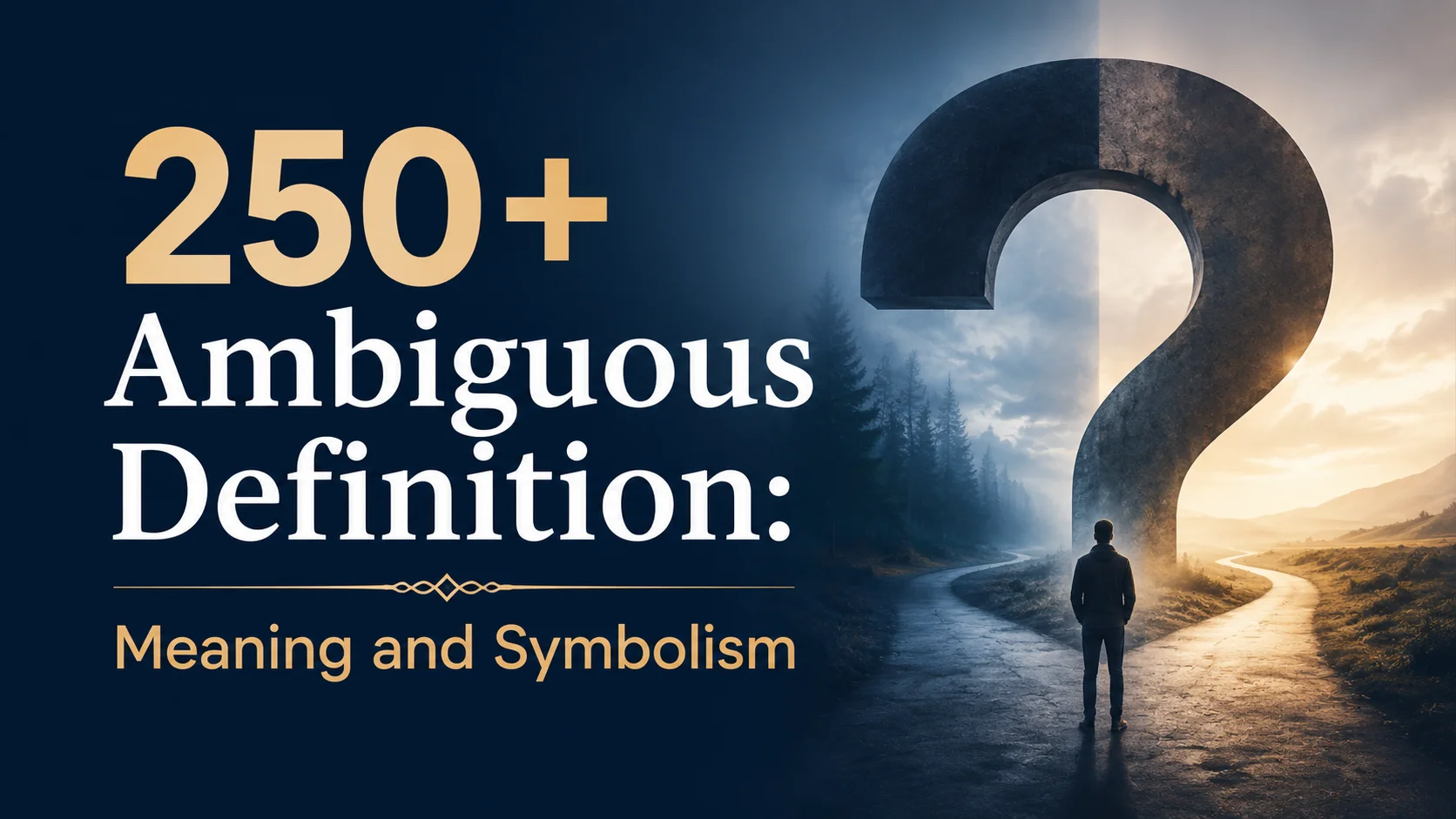
250+ Ambiguous Definition: Meaning and Symbolism shows ambiguity in communication daily language perception phrase meanings two mixed signals.
In the ambiguity of communication, daily language and perception form a phrase where meanings in two or mixed signals appear through gesture, symbol, and ideas shaped by context and concept. An ambiguous definition in usage carries an essence that feels unclear and multi-layered, giving shape as it explores writers, comedians, advertisers, and speakers using intentional misunderstanding in a powerful culture influenced by psychology, history, and influence, where people assign meaning to words in a state of vagueness and uncertainty.
It becomes a puzzle where pieces must fit differently, making it difficult to determine the true intention that may arise in conversations, written texts, jokes, facial expressions, and feeling puzzled while dealing with its impact on thinking processes to decide explicit opinions when faced with brain patterns and missing information, leading to interpretations and viewpoints that are exciting yet challenging in encounters. It requires strategies for understanding and navigating situations, using context clues to consider surrounding details, ask questions, gather clarification, and resolve confusion while trying to enhance multiple perspectives, recognize alternatives, and build critical thinking skills. This helps to evaluate possibilities, weigh evidence, form conclusions, and analyze informed decisions, while referring to situations and ideas in decision-making that supports growth, opportunity, fostering creativity, and flexibility.
🔍 Quick Answer
Ambiguous means something that is open to more than one interpretation. It can feel mysterious, flexible, clever, and thought-provoking. As a name idea, Ambiguous Definition works for characters, mascots, plushies, and creative projects that deserve a title with depth and intrigue.
| Name | Meaning | Origin |
| Enigma | A mystery that invites curiosity | Greek |
| Riddle | A puzzling question or clue | Old English |
| Veil | Something that conceals | Old French/Latin |
| Cipher | A coded or hidden message | Arabic/English |
| Haze | A blurred, unclear view | English |
| Mirage | An illusion that looks real | Arabic |
| Arcane | Secret or known by few | Latin |
| Nebula | A cloud-like form | Latin |
| Sphinx | A symbol of riddles | Greek |
| Obscura | Dark, hidden, unclear | Latin |
| Echo | A lingering sound or idea | Greek |
| Paradox | A statement that seems contradictory | Greek |
| Liminal | Standing between two states | Latin |
🧾 TL;DR
At its heart, Ambiguous Definition is about meaning that is not fixed. It can be artistic, emotional, or symbolic, which makes it perfect for names with mystery and character. For a tiger, mascot, or fictional figure, this kind of name feels dramatic, sophisticated, and memorable. It suggests something worth looking twice at. That is why names tied to ambiguity often feel timeless: they spark questions, create atmosphere, and leave room for imagination.
| Name | Meaning | Origin |
| Mystery | Something not easily explained | Greek/English |
| Shade | A subtle shadow or tone | Old English |
| Twilight | The in-between time of day | Old English |
| Fable | A story with meaning | Latin |
| Rune | A secret letter or symbol | Old Norse |
| Dusk | The close of daylight | Old English |
| Aether | The upper, rare air | Greek |
| Umbra | A shadowed area | Latin |
| Halo | A ring of light | Greek/Latin |
| Flux | Continuous change | Latin |
| Sable | Dark, rich black | French |
| Wisp | A thin, delicate trace | Old English |
| Glimmer | A faint light or sign | Middle English |
❓ What Does Ambiguous Mean?
The word ambiguous describes something that can be understood in more than one way. It is not always a bad thing. In fact, ambiguity can be smart, artistic, and emotionally rich. It gives space for interpretation and lets people bring their own meaning to what they see or hear. That is why the word feels so powerful in storytelling, branding, psychology, and even naming. A name inspired by ambiguity can feel layered, flexible, and unforgettable.
| Name | Meaning | Origin |
| Enigma | Something hard to define | Greek |
| Mirage | A false or shifting image | Arabic |
| Cipher | A hidden code | Arabic/English |
| Hush | Quiet, subtle silence | Old English |
| Veil | A cover that hides detail | Latin |
| Quill | A tool for writing, symbolizing interpretation | Old English |
| Shade | A soft, unclear variation | Old English |
| Mist | A cloud that blurs vision | Old English |
| Arcane | Hidden knowledge | Latin |
| Oracle | A source of prophecy | Greek |
| Nix | Something that vanishes quickly | Latin/Germanic |
| Whisper | A soft, uncertain voice | Old English |
| Cloud | Something drifting and unclear | Old English |
🧩 Core Characteristics
Ambiguity usually has a few signature traits: it can be unclear, flexible, subtle, layered, and open-ended. These traits make it interesting rather than boring. In names, that means you can choose something that feels mysterious without being cold. You can also choose a name that sounds strong but still leaves room for imagination. For a tiger, character, or plushie, ambiguity adds personality because it feels like the name has a story hiding inside it.
| Name | Meaning | Origin |
| Duala | Two-sided or dual | Latin-inspired |
| Paradox | A contradiction that still makes sense | Greek |
| Veil | Hidden but present | Latin |
| Prism | Something that splits light | Greek |
| Echo | A repeated reflection | Greek |
| Drift | A slow, uncertain movement | Old English |
| Flicker | A brief, changing light | Old English |
| Haze | Soft blur | English |
| Lumen | Light, a hint of clarity | Latin |
| Shadow | An outline or hidden form | Old English |
| Ember | A glowing remnant | Old English |
| Ripple | A small wave of change | English |
| Misty | Covered in soft blur | English |
🏺 The Etymology of Ambiguous
The word ambiguous comes from Latin roots tied to moving around or being open to different directions. That history is part of why the word feels so flexible. It suggests motion, uncertainty, and possibility rather than one fixed answer. For naming, that is a gift. A name with an etymological sense of movement or mystery often feels richer because it carries the feeling of a word that has traveled through time.
| Name | Meaning | Origin |
| Ambrose | A classic, timeless name | Greek/Latin |
| Argo | A vessel of journey and discovery | Greek |
| Vagus | Wandering or roaming | Latin |
| Nomad | One who moves from place to place | Greek via Latin |
| Sable | Dark, elegant, shifting | French |
| Aster | Star-like, distant light | Greek |
| Lumen | A unit of light, bright hint | Latin |
| Canto | A song or section of verse | Italian/Latin |
| Terra | Earth, grounded presence | Latin |
| Nova | New star, sudden brightness | Latin |
| Verba | Words, language, expression | Latin |
| Curio | A curious object | Latin via English |
| Atrium | An open inner space | Latin |
🌱 Ancient Linguistic Roots
Ancient languages gave us many words that still feel alive today because they carry images, not just definitions. When a name has ancient roots, it often feels wise, dramatic, or ceremonial. That is perfect for a tiger name, a fantasy character, or a mascot that should feel larger than life. Ambiguity itself has a long intellectual history, so names with old roots naturally match its mood.
| Name | Meaning | Origin |
| Nyx | Night goddess or night | Greek |
| Atlas | One who bears the sky | Greek |
| Selene | Moon goddess | Greek |
| Juno | Queenly, powerful presence | Latin |
| Odin | Wise, all-knowing figure | Old Norse |
| Rune | Mystic sign or letter | Old Norse |
| Isis | Strong, sacred presence | Egyptian |
| Luna | Moon | Latin |
| Asha | Truth, order, hope | Sanskrit |
| Maya | Illusion or creative power | Sanskrit |
| Anka | Grace or favor | Greek/Slavic use |
| Ira | Watchful or strong | Hebrew |
| Zephyr | A gentle west wind | Greek |
🇺🇸 Ambiguity in American Culture
In American culture, ambiguity often shows up in art, advertising, humor, and everyday communication. People sometimes like things that are slightly unclear because they feel clever or stylish. A brand name, a movie title, or a character name that is ambiguous can create curiosity fast. It invites people to look closer. That same feeling can work beautifully in naming because a mysterious name tends to be remembered longer than a plain one.
| Name | Meaning | Origin |
| Maverick | Independent, hard to define | American usage |
| Dakota | Friendly, broad, enduring | Native American |
| Echo | Repeated sound, cultural resonance | Greek |
| River | Always moving, never fixed | English |
| Sky | Open, expansive, uncertain | English |
| Ember | Warm remnant of fire | Old English |
| Aspen | Graceful tree, soft image | English |
| Harper | One who plays or shares stories | English |
| Billie | Strong and spirited | English |
| Indie | Independent and creative | English |
| Scout | One who explores and observes | English |
| Sage | Wise, calm, balanced | Latin/English |
| Jett | Fast, sleek, bold | English |
⚖️ Law and Legal Language
Law depends on precision, so ambiguity can be both useful and dangerous. A phrase that sounds vague may protect flexibility, but it can also create confusion or dispute. That tension makes legal language an especially interesting symbolic space. For naming, legal-inspired words can sound sharp, formal, and intelligent. They are great for mascots, fictional detectives, or characters with authority and mystery.
| Name | Meaning | Origin |
| Clause | A formal statement in law | Latin via French |
| Writ | A written command | Old English |
| Verdict | A formal decision | Latin |
| Statute | A formal law | Latin |
| Plea | A legal request | Latin |
| Docket | A record of cases | English/French |
| Ledger | A written record | English |
| Bail | Security in legal process | Old French |
| Gavel | A judge’s striking tool | Old French |
| Veto | I forbid | Latin |
| Notary | One who records | Latin |
| Lex | Law | Latin |
| Juris | Of law | Latin |
🧠 Psychological Meaning of Ambiguity
Psychologically, ambiguity can create curiosity, tension, or even comfort depending on the person. Some people enjoy uncertainty because it feels creative and open. Others find it stressful because they prefer clear answers. That range is part of the symbolism of ambiguity: it reflects the human mind itself. A name that hints at psychology can feel thoughtful and emotionally layered, especially for a character that is meant to seem reflective or complex.
| Name | Meaning | Origin |
| Insight | Deep understanding | English |
| Mindy | Gentle, thoughtful awareness | Modern English |
| Ponder | To think deeply | English |
| Nova | A sudden mental spark | Latin |
| Calyx | A protective form, layered shell | Greek |
| Muse | Source of inspiration | Greek |
| Clarity | The state of being clear | Latin/English |
| Focus | Concentrated attention | Latin |
| Sora | Sky, open thought | Japanese |
| Karma | Action and consequence | Sanskrit |
| Luna | Moon-like reflection | Latin |
| Aura | A surrounding atmosphere | Latin |
| Echo | A repeated thought | Greek |
📚 Tolerance for Ambiguity
Tolerance for ambiguity is the ability to handle unclear situations without becoming overwhelmed. This idea matters in learning, art, leadership, and relationships. People who tolerate ambiguity often enjoy complexity and nuance. That makes the concept powerful in naming because a name can suggest maturity, balance, and calm confidence even when it is not fully explained. It is a beautiful quality for a tiger name, since tigers already carry strength and poise.
| Name | Meaning | Origin |
| Balance | Evenness and steadiness | English |
| Zen | Calm awareness | Japanese |
| Solace | Comfort in uncertainty | Latin |
| Pax | Peace | Latin |
| Harbor | A safe place to rest | Old English |
| Still | Quiet and composed | English |
| Vale | A calm valley | Latin |
| Haven | Safe refuge | English |
| Quiet | Soft, untroubled silence | Latin/English |
| Ease | Calm comfort | English |
| Flow | Smooth movement | English |
| Grace | Gentle elegance | Latin |
| Truce | A pause in conflict | Old French |
🎭 Ambiguity in Literature and Art
Writers and artists use ambiguity to invite interpretation. A story that is too clear can feel flat, but a little uncertainty gives it depth. Ambiguous art asks the audience to participate, to imagine, and to decide what a scene means. Names inspired by literature and art often sound elegant, dramatic, or symbolic. They are ideal for creatures, mascots, and fictional beings with a creative aura.
| Name | Meaning | Origin |
| Fable | A story with a lesson | Latin |
| Mythos | A traditional story or legend | Greek |
| Sonnet | A structured poem | Italian |
| Muse | A source of inspiration | Greek |
| Canvas | A surface for art | Latin |
| Verse | A line of poetry | Latin |
| Quill | A writer’s tool | Old English |
| Palette | A set of colors | French |
| Aria | A solo melody | Italian |
| Drama | A dramatic work | Greek |
| Etude | A study piece | French |
| Symbol | A sign representing meaning | Greek |
| Echo | A repeated artistic effect | Greek |
✨ Symbolism in Creative Works
In creative work, ambiguity often symbolizes freedom, depth, and mystery. It can suggest that not everything should be explained right away. That is a powerful symbolic choice because it keeps imagination alive. A name from this space should feel expressive and memorable. It should hint rather than shout. That is exactly why symbolic names are so effective for fictional characters, plush toys, pets, and performance mascots.
| Name | Meaning | Origin |
| Symbol | A sign with deeper meaning | Greek |
| Rune | A hidden sign or charm | Old Norse |
| Glyph | A carved symbol | Greek |
| Totem | A sacred emblem | Ojibwe |
| Charm | A magical or attractive sign | Latin |
| Sigil | A secret seal | Latin |
| Icon | An image with meaning | Greek |
| Token | A small sign of value | English |
| Emblem | A representative mark | Greek |
| Crest | A symbol of identity | Latin |
| Banner | A displayed sign | Germanic |
| Talis | A protective sign | Arabic/Latin use |
| Oracle | One who reveals meaning | Greek |
📺 Ambiguity and Modern Media
Modern media loves ambiguity because it keeps audiences talking. Movies, music videos, streaming shows, and online content often use unclear endings or symbolic visuals to spark conversation. That makes ambiguity feel trendy, intelligent, and a little bit addictive. In naming, that same energy creates a title that feels current and artistic at once. A character with an ambiguous name instantly sounds more layered.
| Name | Meaning | Origin |
| Pixel | A tiny unit of visual media | English |
| Stream | Continuous digital flow | English |
| Frame | A single image or scene | English |
| Loop | A repeated cycle | English |
| Remix | A new version of media | English |
| Neon | Bright artificial light | Greek |
| Static | Faint visual noise | Latin |
| Clip | A short media segment | English |
| Click | A sharp digital sound | English |
| Feed | A stream of updates | English |
| Reel | A recorded sequence | English |
| Signal | A transmitted message | Latin |
| Glitch | A sudden system error | Yiddish via English |
📱 Social Media and Mixed Signals
On social media, mixed signals are everywhere. A post can be funny and serious at the same time. A caption can mean one thing to one person and something else to another. This is modern ambiguity in action. It can feel playful, confusing, or clever depending on the context. That makes it a great source of naming inspiration for a character who feels current, expressive, and a little unpredictable.
| Name | Meaning | Origin |
| DM | Direct message, private signal | English |
| Status | A public update or condition | Latin |
| Post | A shared update | Latin |
| Meme | A shared cultural idea | Greek |
| Tag | A label or marker | Germanic |
| Reply | An answer back | English |
| Thread | A connected conversation | English |
| Wink | A playful signal | English |
| Ping | A small digital alert | English |
| Buzz | A lively signal | English |
| Swipe | A quick motion | English |
| Scroll | Move through content | French/English |
| Mood | A felt tone or vibe | Latin/English |
💓 Emotional Associations of Ambiguity
Ambiguity can carry many emotions at once. It may feel exciting, unsettling, romantic, or thoughtful depending on the situation. That emotional complexity is one of the reasons the concept is so powerful. A name inspired by ambiguous feeling can sound tender, brooding, poetic, or even playful. It is a strong choice when you want the name to carry mood instead of just meaning.
| Name | Meaning | Origin |
| Sorrow | Deep sadness | Old English |
| Joy | Happiness and delight | Latin/Old French |
| Hope | A bright expectation | Old English |
| Quiet | Soft emotional stillness | Latin/English |
| Tender | Gentle and caring | Latin/English |
| Velvet | Soft and rich texture | French |
| Solace | Comfort in distress | Latin |
| Bloom | A feeling of becoming | Old English |
| Echo | A lingering emotional tone | Greek |
| Whisper | A soft emotional hint | Old English |
| Ember | Lasting warmth | Old English |
| Aura | A surrounding feeling | Latin |
| Seren | Calm, serene, still | Welsh/English use |
🌊 Common Emotional Responses
People often respond to ambiguity with curiosity, tension, hope, caution, or wonder. Some want to solve it right away, while others enjoy lingering in the unknown. This emotional response is part of why ambiguous names are so memorable. They make people pause. They make people ask questions. In a title or character name, that pause becomes part of the magic.
| Name | Meaning | Origin |
| Curiosity | The urge to know | Latin |
| Wonder | Awe and surprise | Old English |
| Pause | A brief stop | Latin |
| Tension | Tight emotional pressure | Latin |
| Calm | Peaceful steadiness | Latin |
| Pulse | A living beat | Latin |
| Flutter | A light nervous motion | English |
| Chill | Cool emotional quiet | Old English |
| Spark | A sudden small light | Old English |
| Wait | A pause in action | Old English |
| Drift | Slow, uncertain movement | Old English |
| Blink | A quick, fleeting motion | English |
| Breath | A moment of life | Old English |
🪞 Ambiguity as a Symbol
As a symbol, ambiguity often stands for possibility. It can also represent secrets, transitions, transformation, or dual truths. Symbolically, it reminds us that not everything has one simple answer. A name that captures this feeling can be powerful because it gives a character or pet a sense of depth. It says, “There is more here than meets the eye.”
| Name | Meaning | Origin |
| Echo | A symbol of lingering meaning | Greek |
| Veil | A symbol of concealment | Latin |
| Moon | Reflective light in darkness | Old English |
| Key | Something that unlocks meaning | Old English |
| Door | An opening to another place | Old English |
| Path | A route or direction | Old English |
| Rune | A sign of hidden wisdom | Old Norse |
| Seal | A mark of authority | Old English |
| Knot | A binding or puzzle | Old English |
| Star | A distant guiding light | Old English |
| Flame | A shifting symbol of life | Old English |
| Prism | A tool that reveals layers | Greek |
| Orbit | A moving circle of meaning | Latin |
🎨 Symbolic Themes
Ambiguity often appears beside themes like duality, mystery, shadow, reflection, and transformation. These themes make names feel layered and meaningful. They are especially useful when you want a name to sound artistic rather than ordinary. A symbolic name can make even a plushie or mascot feel like a character with a backstory.
| Name | Meaning | Origin |
| Dual | Twofold or paired | Latin |
| Shadow | A hidden outline | Old English |
| Mirror | A reflective surface | Latin |
| Flame | Movement and change | Old English |
| Tide | A rising and falling force | Old English |
| Spiral | A turning pattern | Latin |
| Crown | A symbol of power | Latin |
| Root | A hidden foundation | Old English |
| Branch | A spreading form | Old English |
| Stone | Stability and endurance | Old English |
| Silk | Soft elegance | Old English |
| River | Movement and direction | Old English |
| Thorn | Beauty with sharpness | Old English |
🌍 Ambiguity Across Cultures
Different cultures interpret ambiguity in different ways. In some places, it is linked to wisdom and artistic sensitivity. In others, it may be tied to caution or uncertainty. That global variety makes ambiguity a fascinating naming theme. A name inspired by cross-cultural ideas can feel worldly, refined, and full of depth. It can also make a character seem timeless.
| Name | Meaning | Origin |
| Kismet | Fate or destiny | Turkish/Arabic |
| Karma | Action and consequence | Sanskrit |
| Maya | Illusion or creative power | Sanskrit |
| Asha | Hope, truth, or life | Sanskrit |
| Hana | Flower or grace | Japanese/Hebrew |
| Sora | Sky | Japanese |
| Leif | Descendant or heir | Old Norse |
| Noor | Light | Arabic |
| Amara | Eternal or unfading | Greek/Sanskrit |
| Zuri | Beautiful | Swahili |
| Saanvi | Knowledge and grace | Sanskrit |
| Eira | Snow or mercy | Welsh |
| Nia | Purpose | Welsh |
🗣️ Cultural Perspectives
Cultural perspective shapes whether ambiguity feels charming or frustrating. In some storytelling traditions, it is a sign of depth. In business, it may be used carefully to leave room for interpretation. In daily life, it can be either poetic or annoying. That balance is what makes the concept so rich for names. A culturally inspired name can sound elegant, meaningful, and versatile.
| Name | Meaning | Origin |
| Sage | Wise and balanced | Latin/English |
| Lotus | Sacred flower of meaning | Greek/Asian use |
| Karma | Fate through action | Sanskrit |
| Mira | Wonder or ocean | Latin/Slavic/Sanskrit use |
| Aria | Air or melody | Italian/Latin |
| Noor | Light | Arabic |
| Taro | Big or first-born | Japanese |
| Leela | Play, divine play | Sanskrit |
| Rumi | A poetic, spiritual name | Persian |
| Amani | Wishes or peace | Arabic |
| Imani | Faith | Swahili |
| Dara | Wise or gifted | Khmer/Hebrew use |
| Zain | Beauty and grace | Arabic |
💞 Ambiguity in Relationships
In relationships, ambiguity can feel romantic, confusing, or emotionally charged. Mixed messages create tension because people want clarity, yet sometimes uncertainty adds spark. That is why ambiguity has such strong symbolic power in this space. A relationship-themed name can feel soft, dramatic, or emotionally complex. It is ideal for a character who is affectionate but mysterious.
| Name | Meaning | Origin |
| Bond | A connection between people | English |
| Spark | A sudden emotional start | Old English |
| Kiss | A sign of affection | Old English |
| Charm | Attraction or warmth | Latin |
| Muse | One who inspires love/creativity | Greek |
| Heart | Emotional center | Old English |
| Vow | A promise | Old English |
| Thread | A connecting line | Old English |
| Lilt | A light, pleasing rhythm | English |
| Embrace | To hold close | Latin |
| Darling | Beloved or dear | Old English |
| Affinity | Natural closeness | Latin |
| Serene | Calm and gentle | Latin |
💬 Mixed Signals
Mixed signals are the everyday face of ambiguity. They happen when words, actions, or emotions do not fully match. This can be frustrating, but it also makes a powerful theme for naming because it suggests a character that is layered and hard to read. A name in this category should feel subtle, cool, and slightly elusive.
| Name | Meaning | Origin |
| Signal | A sign or message | Latin |
| Wink | A playful hint | English |
| Veer | To turn aside | English |
| Shift | A change in direction | English |
| Twist | A sudden turn | Old English |
| Hint | A small clue | English |
| Nudge | A gentle push | English |
| Cue | A prompt or sign | French |
| Flare | A brief burst | English |
| Blink | A quick signal | English |
| Drift | To move without certainty | Old English |
| Pulse | A beating sign of life | Latin |
| Flick | A quick motion | English |
🏷️ Ambiguity in Branding and Advertising
Brands often use ambiguity strategically. A vague name can feel premium, stylish, and memorable because it leaves room for imagination. It can also make people curious enough to explore more. That is why ambiguous branding is such a useful creative tool. For naming, it suggests confidence: the name does not need to explain everything right away.
| Name | Meaning | Origin |
| Nova | New and striking | Latin |
| Vanta | Dark and sleek feel | Modern coined |
| Aura | Atmosphere or presence | Latin |
| Halo | A bright ring effect | Greek/Latin |
| Luxe | Luxury and polish | French |
| Vale | A graceful valley | Latin |
| Axis | A central line | Latin |
| Vista | A broad view | Latin |
| Vogue | Style and trend | French |
| Prism | A layered light effect | Greek |
| Emblem | A sign of identity | Greek |
| Tempo | A sense of timing | Italian/Latin |
| Zenith | Peak or highest point | Arabic |
🎯 Strategic Vagueness
Strategic vagueness is when a message is intentionally a little unclear so it can work in more than one situation. In storytelling, marketing, or naming, this can be very powerful. It leaves room for interpretation while still feeling intentional. A name with this energy sounds polished, modern, and a bit mysterious. It can make a tiger, mascot, or fictional figure feel unforgettable.
| Name | Meaning | Origin |
| Vague | Not fully defined | Latin via French |
| Shade | A subtle degree or shadow | Old English |
| Blur | Something not sharply seen | English |
| Haze | Soft obscuring mist | English |
| Cloak | A covering layer | Old English |
| Cloak | A covering layer | Old English |
| Mantle | A protective covering | Latin |
| Cloud | Soft and changeable | Old English |
| Smoke | Elusive and shifting | Old English |
| Fog | Dense, unclear mist | Old English |
| Veil | A light covering | Latin |
| Hint | A gentle suggestion | English |
| Glint | A small flash of light | Middle English |
📊 Ambiguity Table: Context and Meaning
When people talk about ambiguity, context matters more than anything else. The same word can seem poetic in one setting and problematic in another. That is why this section is useful: it shows how flexible the idea can be. For naming, this means you can choose a word that fits the tone you want, whether soft, smart, dramatic, or playful.
| Name | Meaning | Origin |
| Context | The setting that shapes meaning | Latin |
| Clue | A helpful hint | Middle English |
| Frame | A structure for interpretation | English |
| Lens | A way of seeing | Latin |
| Angle | A point of view | French/Latin |
| Tone | Emotional color or quality | Greek/Latin |
| Mode | A way or manner | Latin |
| Layer | A covering level | French |
| Signal | A meaningful sign | Latin |
| Draft | A rough version | Old English |
| Version | A variation of something | Latin |
| Thread | A connected line | Old English |
| Pattern | A repeated design | Old French |
🚫 Misunderstandings About Ambiguity
A common misunderstanding is that ambiguity always means weakness, confusion, or dishonesty. That is not true. Ambiguity can be intentional, artistic, and even elegant. It can invite curiosity instead of confusion. It can create space for thought instead of forcing a quick answer. A name built around this idea should feel smart and balanced rather than messy.
| Name | Meaning | Origin |
| Honest | Clear and truthful | Old English |
| Plain | Simple and direct | Latin via French |
| Direct | Straight to the point | Latin |
| Clear | Easy to understand | Latin |
| True | Accurate and real | Old English |
| Open | Not hidden | Old English |
| Frank | Straightforward | Old French |
| Crisp | Sharp and clear | English |
| Sharp | Clear and exact | Old English |
| Bright | Easily seen or understood | Old English |
| Simple | Uncomplicated | Latin |
| Pure | Unmixed and clear | Latin |
| Clean | Free from clutter | Old English |
🪄 Clarifying the Difference
Ambiguity is not the same as confusion, and symbolism is not the same as vagueness. Clarifying these differences helps the concept feel richer. Ambiguity suggests layered meaning; confusion suggests lack of order. Symbolism suggests an intentional deeper message; vagueness suggests lack of detail. A name that lives in the middle of these ideas can feel sophisticated and emotionally interesting.
| Name | Meaning | Origin |
| Order | Arrangement and structure | Latin |
| Logic | Reasoned thought | Greek |
| Signal | A meaningful sign | Latin |
| Mark | A visible indication | Old English |
| Detail | A small exact part | French |
| Focus | Centered attention | Latin |
| Clarity | Being clearly seen or understood | Latin |
| Sense | Meaning or reason | Latin |
| Reason | Logical thought | Latin |
| Proof | Evidence | Latin |
| Fact | Something known to be true | Latin |
| Note | A small written sign | Latin |
| Point | A precise mark | Latin |
⏳ How the Meaning of Ambiguity Has Shifted Over Time
Over time, ambiguity has moved from being mostly a problem to being something people sometimes value. In older formal settings, unclear language could be seen as risky. In modern art, literature, and branding, a little uncertainty can feel beautiful or clever. That shift makes ambiguity a much stronger naming theme today because it carries both historical depth and modern style.
| Name | Meaning | Origin |
| Olden | Ancient or from the past | English |
| Legacy | Something passed down | Latin |
| Echo | A lasting repetition | Greek |
| Ancient | Very old | Latin |
| Modern | Current or recent | Latin |
| Shift | A change over time | English |
| Era | A period of time | Latin |
| Age | A span of time | Latin |
| Trend | A direction of change | Old English |
| Novel | New and different | Latin |
| Retro | Inspired by the past | Latin |
| Timeline | Ordered time sequence | English |
| Future | What comes next | Latin |
🌟 Modern Shifts
Today, ambiguity feels more accepted in music, film, online identity, and personal branding. People often like names that are not too literal because they feel more stylish and memorable. That modern shift is part of why Ambiguous Definition works so well as a creative concept. It sounds thoughtful, trendy, and a little artistic. It gives a name room to breathe.
| Name | Meaning | Origin |
| Trend | What is currently popular | English |
| Viral | Widely shared fast | Latin |
| Wave | A current movement | Old English |
| Glow | A soft modern shine | Old English |
| Vibe | A feeling or atmosphere | English |
| Neo | New | Greek |
| Flux | Constant change | Latin |
| Spark | A small burst of energy | Old English |
| Mode | A current style | Latin |
| Pixel | A tiny visual unit | English |
| Stream | A flowing digital line | English |
| Remix | A reworked version | English |
| Fresh | New and lively | Old English |
Read More: Lumon Definition and Meaning Explained Language & Usage
🌟 Benefits of Using the Name Ambiguous Definition
Using Ambiguous Definition as a name can give your character, mascot, or project a memorable identity. It stands out because it feels clever without being loud. It also carries depth, which helps it stay interesting over time.
- It sounds mysterious and intelligent.
- It creates instant curiosity.
- It works for fantasy, art, or branding.
- It feels modern and meaningful.
- It leaves room for personal interpretation.
- It is easy to make symbolic and memorable.
❓ FAQs
What is the simple definition of ambiguous?
Ambiguous means having more than one possible meaning or interpretation.
Is ambiguity always negative?
No. It can be artistic, thoughtful, poetic, and useful in many creative settings.
Why is ambiguity important in psychology?
It helps explain how people handle uncertainty, mixed signals, and open-ended situations.
Can ambiguous language cause legal problems?
Yes. In law, unclear wording can lead to disputes or different interpretations.
How is ambiguity used in art?
Artists use it to invite imagination, emotional depth, and personal interpretation.
Does ambiguity mean dishonesty?
Not always. Sometimes it is intentional, subtle, or simply open-ended.
Conclusion
Ambiguous Definition is more than just a phrase. It is a creative idea full of symbolism, mystery, and possibility. Whether you are naming a tiger, a plushie, a mascot, or a fictional character, this theme gives you a name that feels layered and unforgettable. It works because it does not try too hard to explain itself. Instead, it leaves room for imagination.